- The Story
The Verse That Caught My Attention
Jonah 1:17 — “Now the LORD provided a huge fish to swallow Jonah.”
Jonah had just been thrown into the sea. The sailors had taken him and cast him overboard, and he was sinking into the depths. From this point, we could imagine the story ending there. Jonah’s disobedience had caught up with him, and perhaps this was the consequence of his running away.
But the next verse tells us something unexpected: “Now the LORD provided a huge fish to swallow Jonah.”
The word that stood out to me was not swallowed, but provided.
I had always imagined the great fish as a tragedy, perhaps even a representation of God’s punishment. But as I read the verse again, I began to see it differently. What seemed like the worst thing that could happen to Jonah was actually an act of God’s provision.
The Lord had not abandoned him to the sea. Even there, He had made a way to preserve him.
The God Who Pursues
As I spent more time reading through the book of Jonah, I began to notice something beyond the assignment God had given him.
Of course, the Lord wanted Nineveh to hear His message. But I began to see another side of the story: God was also pursuing the heart of His prophet.
Throughout the book, I see a God who knows what is hidden beneath Jonah’s heart. He knows Jonah’s reluctance, his resistance, and even the things Jonah struggles to understand about His character. Yet, the Lord continues to pursue him.
I began to imagine what the story would look like if it had ended a few verses earlier, with Jonah being thrown into the sea. There would be no fish, no prayer from the belly, and no continuation of the story.
But the Lord provided.
It made me reflect on how God relates to us. Sometimes, we become so focused on the assignments He has given us that we overlook how He is also pursuing our own hearts.
He is not merely interested in what we can accomplish for His Kingdom. He desires that we come to know His heart, understand His ways, and become one with what He is doing.
Even in our running away, He sees us. He sees where we are, but He also sees what lies beneath the surface: the fears, the lies we believe, and the things that keep us from drawing near to Him.
Never Beyond His Sight
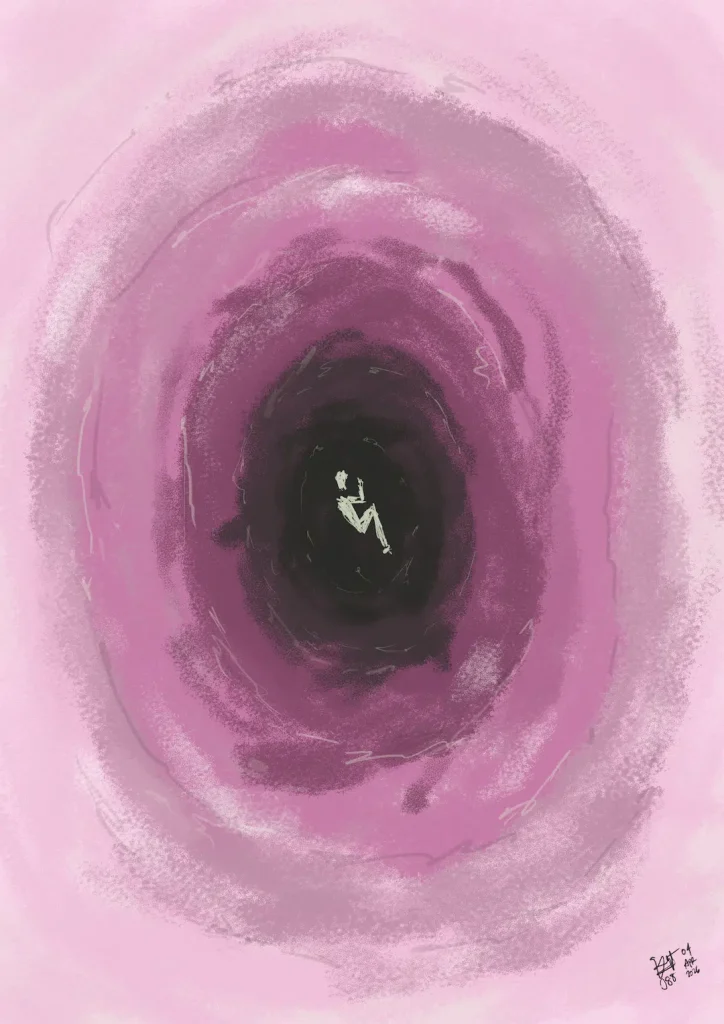
There are a few details in this painting that carry this revelation.
In its original portrait orientation, the figure appears to be curled up in a fetal position, surrounded by a dark space and a pinkish outer layer. This represents Jonah inside the belly of the great fish.
But when the painting is rotated ninety degrees to the right, the same figure takes on another posture. What first appeared to be someone curled up becomes someone bowing down before the Lord.
I see this as Jonah praying from inside the belly of the fish, as described in Jonah chapter 2. What appeared to be a place of confinement becomes a place of prayer and surrender.
There is another detail that becomes visible when looking at the painting in landscape orientation. From a distance, the figure at the center resembles a reflection within someone’s pupil.
This reminds me of Psalm 139: even when we run, we are never beyond God’s sight. There is nowhere we can go where His presence cannot reach us, not even in the depths of the sea.
I began to see that the Lord does not only see our outward circumstances. He sees what is happening within us, too. He knows where we are, what we are carrying, and what is hidden beneath our hearts.
We may think we have wandered too far, but we have never wandered beyond His sight.
The Sign of Jonah
There is one more layer to this painting that I find especially meaningful.
When Jesus spoke about the sign of Jonah in Matthew 12:40, He drew a connection between Jonah’s three days and three nights in the belly of the fish and the Son of Man’s three days and three nights in the heart of the earth.
This connection is expressed through the inverted colors of the painting.
In its original form, the figure represents Jonah: a dark center surrounded by a pinkish layer, representing the belly of the fish.
When the colors are inverted, another image emerges. The figure remains in the same fetal position, but the surroundings become white, with a greenish outer layer representing the earth. I see this as a reflection of Jesus in the belly of the earth, with the glory He radiates.
Jonah’s story points us toward a greater sign: Jesus Himself.
The fish was God’s provision to preserve Jonah, but Jesus went into the grave to accomplish something far greater. He gave Himself to ransom us and make a way for us to return to the Father.
I began to see this as the greatest evidence of God’s pursuit of our hearts. The same God who pursued Jonah is still pursuing us today. He has not changed.
And yet, at the end of Jonah’s story, the Lord leaves a question open. He reveals His heart, but does not force Jonah to respond.
Perhaps this is where the invitation reaches us, too.
The Lord sees us. He knows where we are, and He knows what is hidden within our hearts. Even when we run, He continues to pursue us. And through Jesus, He has made the way for us to return.
Now, how will we respond?
Will we believe, agree, and become one with the heart of the One who has been pursuing us all along?